Private experiment · Systems architecture · Active research
AthenaRampancy
A single-user desktop system investigating how routed computation, persistent memory, tools, and connected context can remain visible, bounded, and operable from one control surface.
- My work
- Architecture, interaction design, visual system, TypeScript implementation, test design
- Runtime
- Bun · Hono · SolidJS · Tauri · SQLite / Drizzle · WebGL
- Mode
- Private, single-user, local-first desktop and service process
- Review
- Source snapshot inspected and rebuilt 14 July 2026

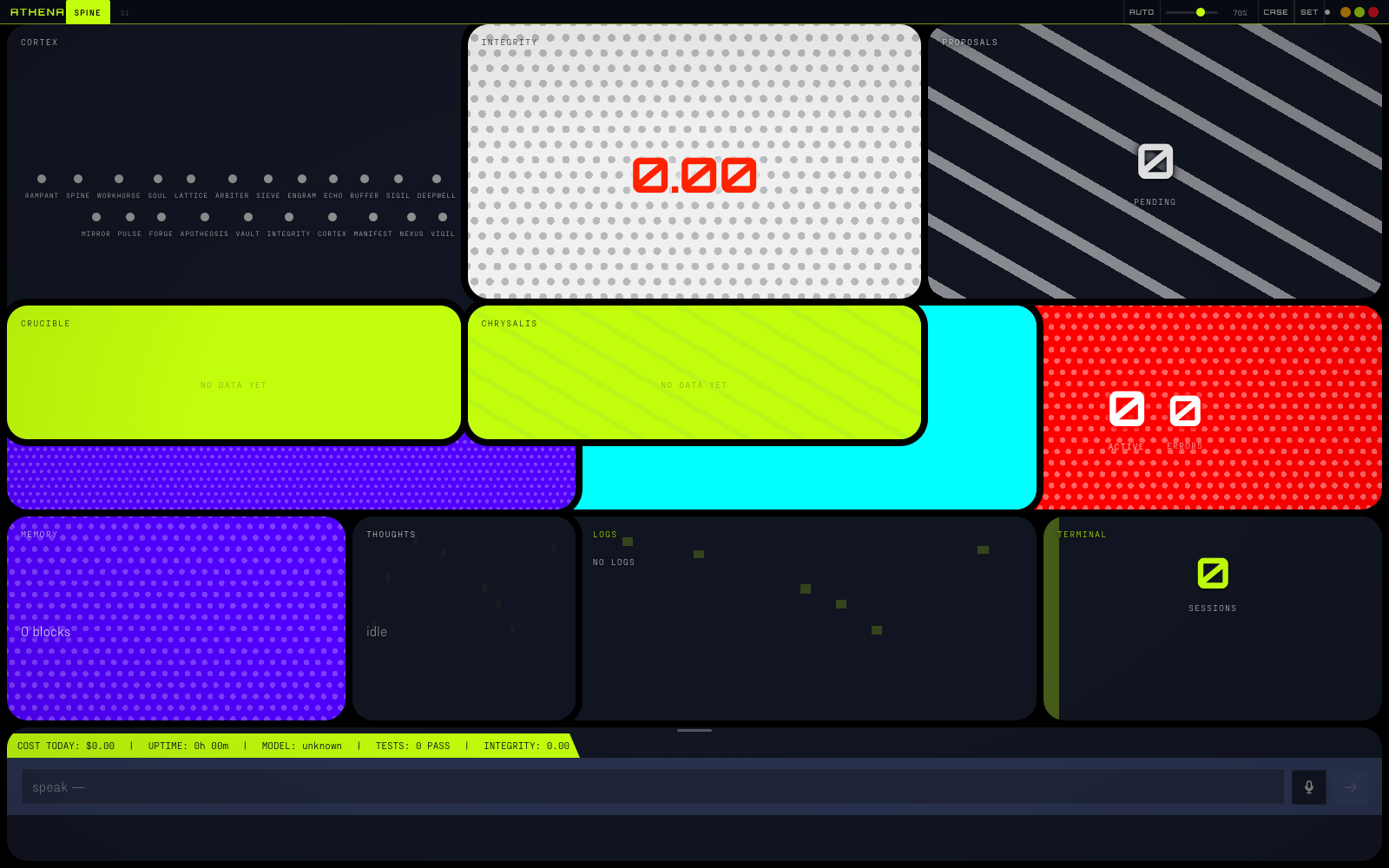
Project boundary. Athena is a private experimental system, not a public service or a claim of autonomous intelligence. This case study documents implemented architecture, interface work, and the places where the research code is intentionally still unresolved.
01 · Routing and cost governance
Request routing and cost control.
Athena does not send every interaction through the same model. A cache gate, intent classifier, and confidence evaluator select a route; the streaming path can still escalate when its first answer proves weak.
Cache gate
A prior local match may answer routine work without a provider call.
The Sieve
Rules classify the request profile and confidence.
Tier route
The request enters a route suited to the work.
Arbiter
Weak streamed output can be interrupted and escalated.
Commit
The route, trace, relative cost, and outcome are recorded.
Supporting recordRouting governanceCost records, research budgets, and execution caps
Cost instrumentation
Cost records for every route.
- Provider calls
- Input, output, and prompt-cache tokens are costed by model and stored by tier.
- Voice
- Synthesis records character use and estimated cost beside model traffic.
- Reporting
- Daily totals, tier breakdowns, history, and configured limits are exposed to the dashboard.
Research governor
Budgets and caps for experimental processes.
- Before execution
- Self-testing, curation, prompt work, and tool synthesis check an estimated spend.
- Caps
- Per-proposal and weekly hard caps; selected recurring activity also observes a daily total.
- After execution
- Actual spend and activity metadata are written to a separate improvement ledger.
02 · Memory and knowledge retrieval
Memory is a set of stores, not one transcript.
Small working blocks remain immediately available. Older knowledge is retrieved from distinct stores, ranked with provenance, and packed to a fixed context budget before it reaches a model.
- 01A write-ahead buffer makes recent block edits readable before the SQLite flush completes.
- 02Block edits retain before/after state, reason, source, tier, and time for later inspection.
- 03Multi-hop retrieval can extract entities from the first result set and issue a second bounded query.
- 04Vault storage is implemented, but its Deepwell retrieval adapter remains an explicit open edge.
03 · Connected context
Time, voice, and external state enter through adapters.
Calendar, health, task, and speech features sit outside the core pipeline. Each can be absent without preventing the local interface and memory system from running.
Schedule and context
- Calendar
- Read and create event paths; multiple labelled Google accounts are supported.
- Tasks
- A periodic scheduler checks due and overdue work and broadcasts reminders over active sockets.
- Fitness
- The Fitbit adapter refreshes OAuth tokens and exposes selected metrics when configured.
Optional speech path
- Input
- Recorded audio is posted to a transcription route and returned as text.
- Output
- Text-to-speech can return or stream MP3 audio; character cost is logged.
- Failure mode
- Routes return a clear unavailable state when provider credentials are not configured.
04 · Desktop control surface
Desktop operational surfaces.
The desktop is organised as an asymmetric instrument panel rather than a single chat column. Runtime state, memory, cost, integrity, tools, proposals, logs, and terminal sessions remain independently visible.
05 · Operational boundaries
Implemented controls and current limits.
The current system has authentication, validation, cost records, timeouts, and rollback surfaces. Those controls make experiments inspectable; they do not turn research code into a hardened multi-user product.
Authenticated surface
HTTP routes require a bearer token except the health check. A socket must authenticate in its first message before work begins.
Configuration gates
Provider and connected-service credentials are read from environment configuration; absent adapters disable themselves.
Process boundary
Synthesised tool trials run in a temporary Bun subprocess with an environment allowlist, timeout, captured output, and cleanup. It is not an OS security sandbox.
Storage controls
Vault paths reject traversal and reserved input; per-project storage limits, checksums, versions, and deletion paths are explicit.
Supporting recordImplementation registerCurrent status, source evidence, build checks, and known failures
| Area | Status | Evidence in the current source |
|---|---|---|
| Routing + providers | Implemented | Streaming pipeline, cache bypasses, tier selection, escalation, tools, traces, and cost logs. |
| Memory + retrieval | Implemented | Editable blocks, write-ahead buffer, SQLite archive, graph retrieval, BM25 fusion, and token packing. |
| Desktop surfaces | Implemented | SolidJS dashboard, WebGL subsystem view, Tauri shell, terminal surface, and secondary hardware display. |
| Calendar + voice | Implemented adapters | Google Calendar and Fitbit adapters; speech-to-text and voice synthesis remain configuration-dependent. |
| Vault retrieval | Partial | Versioned vault storage exists; the Deepwell vault source is declared but not yet connected. |
| Adaptive systems | Experimental | Prompt evolution, tool synthesis, self-testing, mood, and anticipation layers remain research work. |